

Introduction
Choosing a reliable pepper mill supplier in China is not simply about finding a manufacturer that offers the lowest price or the largest product catalog.
For professional buyers, distributors, and businesses serving restaurants or commercial kitchens, the real challenge is finding a supplier who can consistently deliver stable quality, reliable performance, and products that match real customer expectations.
My name is Dora Liu, and I founded Pepper Mill Sourcing because I believe that choosing the right product and the right supplier is more important than simply chasing lower costs.
Before starting this sourcing business, I worked in cross-border e-commerce and managed overseas online sales channels.
During those years, I saw many pepper mills and salt grinders being sold on international markets.
Many products looked attractive in pictures.
They had stylish designs, competitive prices, and strong marketing.
However, after customers actually used them, many products received negative feedback.
The problems were often hidden behind the appearance:
- The grinder stopped working after a short period of use.
- The grinding performance became inconsistent.
- The mechanism was difficult to clean.
- The wooden body had poor finishing.
- The product looked premium but did not feel durable.
These experiences changed the way I look at pepper mills and salt grinders.
A good product is not defined by appearance or price.
It is defined by whether customers can trust it after months or years of daily use.
1. Do Not Choose a Supplier Only Because They Offer Many Designs
When buyers search for pepper mill suppliers in China, they often see suppliers offering hundreds of different styles.
At first glance, this looks impressive.
A large selection of designs seems to mean more choices and more opportunities.
However, more designs do not always mean better quality.
For wooden pepper mills and salt grinders, the appearance is only one part of the product.
The real quality comes from:
- the selection of wood materials;
- the precision of woodworking;
- surface finishing details;
- the durability of internal grinding components;
- the consistency between samples and mass production.
A supplier may create many attractive designs, but if the grinding mechanism is unreliable, the product will eventually disappoint customers.
For a daily-use kitchen tool, performance matters more than decoration.
2. Always Evaluate Sample Quality Before Placing Orders
A reliable supplier should always be judged by the quality of their samples.
For wooden pepper mills, buyers should carefully check:
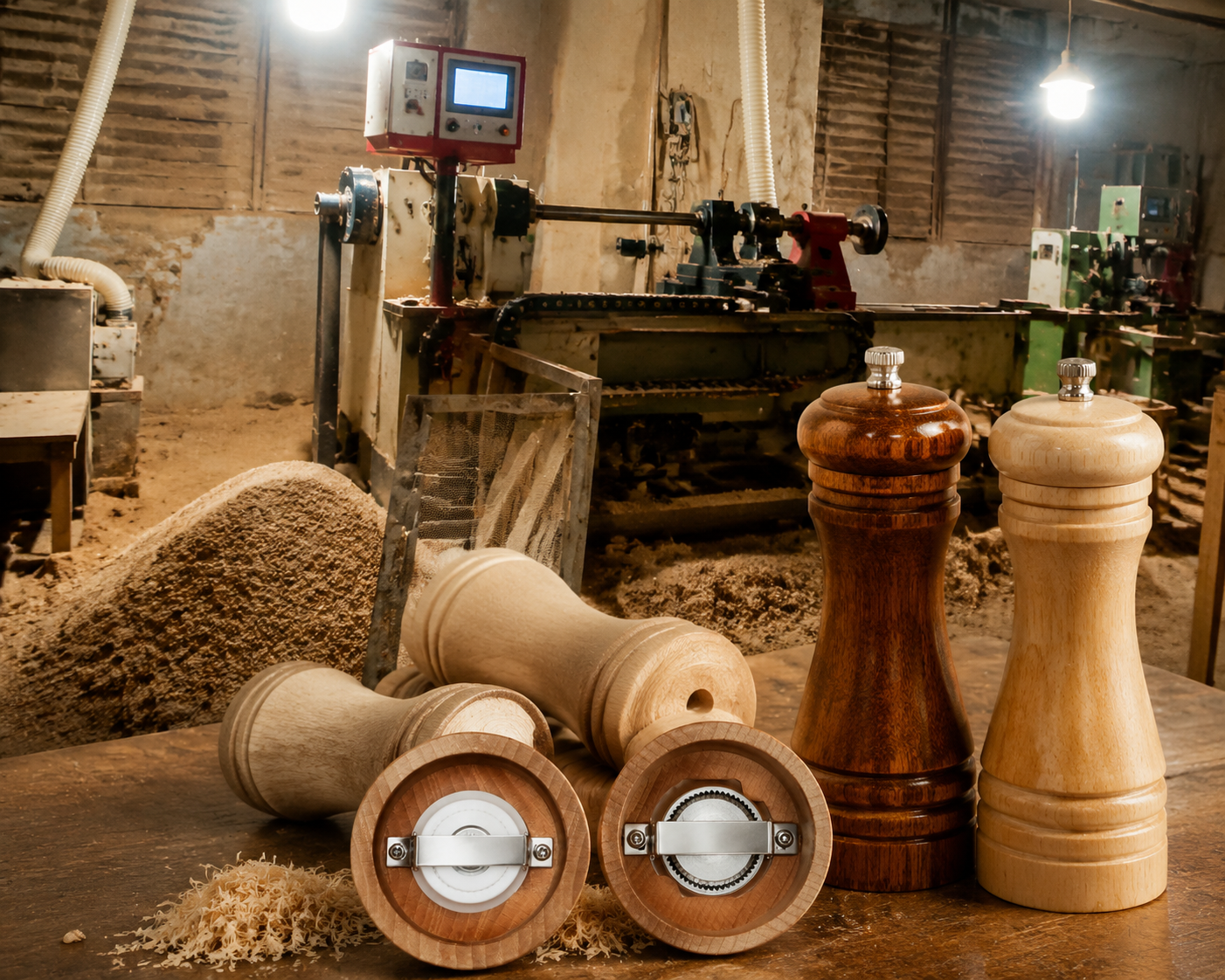
Wooden Craftsmanship
The wooden body represents the first impression of the product.
Pay attention to:
- smoothness of the surface;
- quality of polishing;
- coating consistency;
- edge finishing;
- overall feeling in hand.
A good wooden grinder should feel solid and comfortable.
Small details reveal the supplier’s attitude toward quality.
Grinding Mechanism
The grinding mechanism is the core of a pepper mill.
A beautiful wooden body cannot hide a poor internal system.
Before purchasing, buyers should understand:
- What material is used for the grinding mechanism?
- Is it designed for frequent use?
- Is the grinding performance stable?
- Can replacement parts or maintenance be supported?
Low-cost products often reduce price by using cheaper components.
The result may be a lower purchase cost, but higher customer complaints after selling.
3. A Bigger Factory Does Not Always Mean a Better Supplier
Many overseas buyers naturally focus on factory size.
They ask:
“Is this supplier’s factory large enough?”
“Does this factory have advanced equipment?”
These questions are reasonable, but for traditional products like wooden pepper mills, they are not always the most important factors.
Wooden grinders are not high-tech products.
Their manufacturing relies on traditional woodworking skills, machining experience, and quality control.
The key question is:
Does the supplier truly care about product quality?
A supplier with a smaller production scale but strong quality discipline can sometimes provide better products than a large factory focused only on volume.
4. Pay Attention to the Difference Between Samples and Mass Production
One of the biggest challenges in sourcing is maintaining consistency.
Some suppliers can provide excellent samples.
However, when the order quantity increases, quality may become inconsistent.
Common problems include:
- different wood quality;
- uneven finishing;
- inconsistent assembly;
- weaker internal components.
This is why buyers should not only evaluate samples.
They should also understand the supplier’s production control process.
A reliable supplier should be willing to support:
- sample approval;
- production inspection;
- finished product checking;
- quality verification before shipment.
Good suppliers are not afraid of inspection because they trust their own process.
5. Choose a Supplier Who Understands the Real Usage Scenario
A good supplier does not only manufacture products.
They understand how customers use them.
Commercial users such as:
- restaurants;
- hotels;
- catering companies;
- kitchen suppliers
care about practical performance.
They need products that are:
- durable;
- easy to clean;
- stable during daily operation;
- comfortable to use.
A supplier who only focuses on making a product look attractive may not understand these real needs.
6. Certification and Compliance Should Not Be Ignored
For international buyers, compliance requirements are important.
A reliable supplier should be willing to cooperate with:
- food-contact safety requirements;
- testing procedures;
- certification documents;
- market-specific requirements.
Some suppliers avoid these processes because they increase cost.
However, professional suppliers understand that compliance is part of long-term cooperation.
7. Why I Choose Quality Over Low-Cost Competition
China has a huge manufacturing ecosystem for kitchen products.
My hometown, Yangjiang, Guangdong, is one of the well-known areas for kitchen tool production.
Within a small area around my hometown, it is easy to find many small workshops producing different types of kitchen products, including low-cost pepper mills and salt grinders.
Finding suppliers is not difficult.
Finding suppliers who truly focus on quality is much harder.
From my previous cross-border e-commerce experience, I have seen many low-cost grinders receive poor customer reviews on international platforms.
The problem was usually not the product appearance.
The problem was:
- weak grinding performance;
- poor internal components;
- short service life;
- lack of attention to user experience.
That is why I decided not to compete in the lowest-price market, a choice I explain in more detail in why we focus on quality over low-cost pepper mills.
Instead, I focus on sourcing commercial-quality pepper mills and salt grinders that are practical, durable, and designed for long-term use.
8. The Supplier I Choose Shares the Same Philosophy
During my product sourcing journey, I found a supplier whose philosophy matched my own.
This supplier has focused on commercial channels in China for many years.
Through working directly with restaurants and professional users, they understood an important fact:
A good grinder does not need endless design changes.
It needs reliable performance.
Instead of creating countless decorative styles, they focused on improving the most important parts:
- grinding mechanism quality;
- material selection;
- product durability;
- practical user experience.
Before creating Pepper Mill Sourcing, I had already introduced these products to domestic retail channels.
The customer feedback gave me confidence.
The products received consistently positive reviews because users cared about what really matters:
A grinder that works well and lasts.
That is the reason I decided to introduce these products to global buyers.
Conclusion
Choosing a reliable pepper mill supplier in China requires looking beyond price and appearance.
The best supplier is not necessarily the one offering the most designs or the lowest quotation.
A reliable supplier should understand:
- product quality;
- customer expectations;
- commercial usage;
- long-term cooperation.
For pepper mills and salt grinders, quality starts from the inside.
The grinding mechanism, materials, craftsmanship, and production control determine whether a product can truly stand the test of time.
At Pepper Mill Sourcing, my goal is simple:
To help global buyers find reliable grinding products that customers can trust.
If you are looking for a reliable partner for wooden pepper mills and salt grinders, feel free to contact me for sourcing advice or a quotation.
Related Reading
- Sourcing Pepper Mills from China: Understanding the Real Manufacturing Origins
- Why Cheap Pepper Mills Fail: Common Problems Buyers Should Know
- Why Powder Residue Matters: How a Better Pepper Mill Design Makes Cleaning Easier
- Why We Focus on Quality Over Low-Cost Pepper Mills
- Frequently Asked Questions