
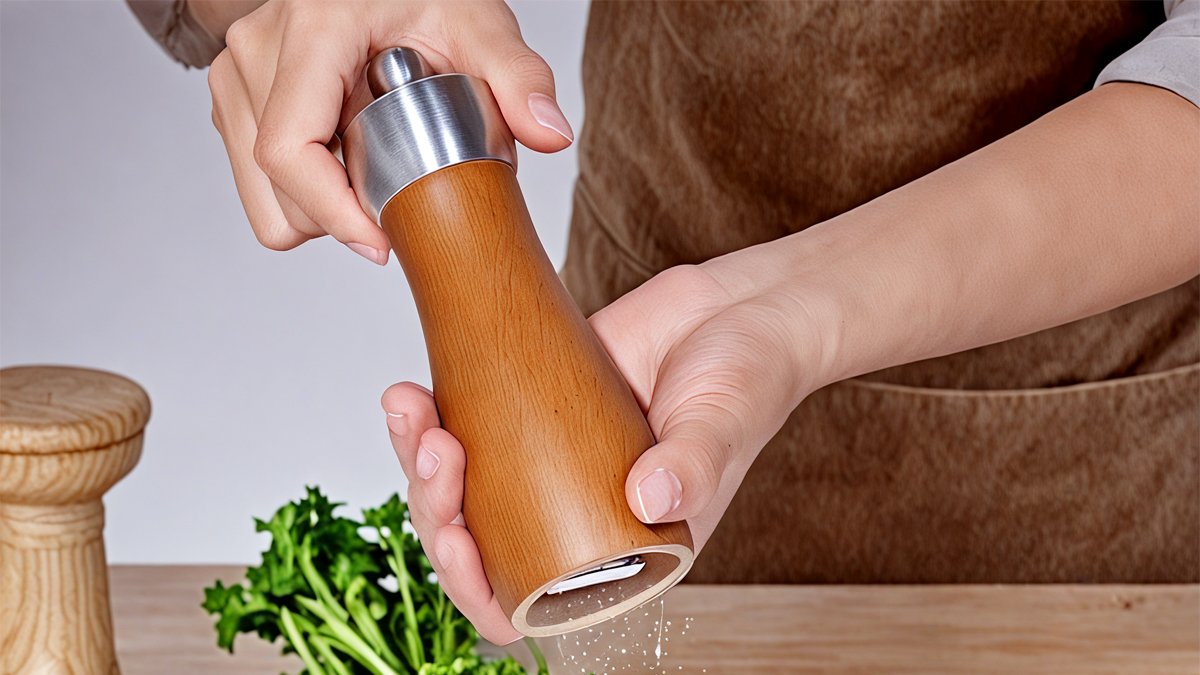

Choosing an easy to turn pepper mill is not only about finding a mechanism that feels loose or effortless. For B2B buyers, turning comfort is a practical product-quality issue that should be checked during sample evaluation.
A pepper mill can look excellent in photos and still be uncomfortable to use. Product dimensions, wood type, finish, mechanism material, and price can all be compared on a specification sheet. Turning comfort cannot.
It needs to be checked with an actual sample and actual peppercorns.
Quick Summary for Sourcing Managers
An easy-to-turn pepper mill depends on two things working together: comfortable grip and controlled grinding resistance. When evaluating samples, test the mill with actual peppercorns at both coarse and fine settings. Do not judge turning quality by rotating an empty mechanism or checking one sample only.
Why Turning Resistance Happens: Grip vs. Mechanical Resistance
When a pepper mill feels difficult to turn, the problem usually comes from one of two areas.
The first is grip. The body may be too wide, too smooth, or difficult to hold securely. The top knob may be too small or slippery. A tall or heavy mill can also require more effort to stabilize during repeated grinding.
The second is mechanical resistance. This can be affected by the grind setting, mechanism alignment, peppercorn feeding, and the construction of the grinding components.
These two issues should be evaluated separately.
A comfortable wooden body cannot compensate for a mechanism that catches during rotation. At the same time, a smooth mechanism does not make a pepper mill comfortable if the user has to squeeze the body tightly to control it.
For B2B sourcing, the goal should not simply be to find the mill with the lightest turn. The better target is smooth, predictable resistance combined with a secure grip.
Key Factors Affecting Pepper Mill Turning Comfort
1. Body Ergonomics and Grip Surface
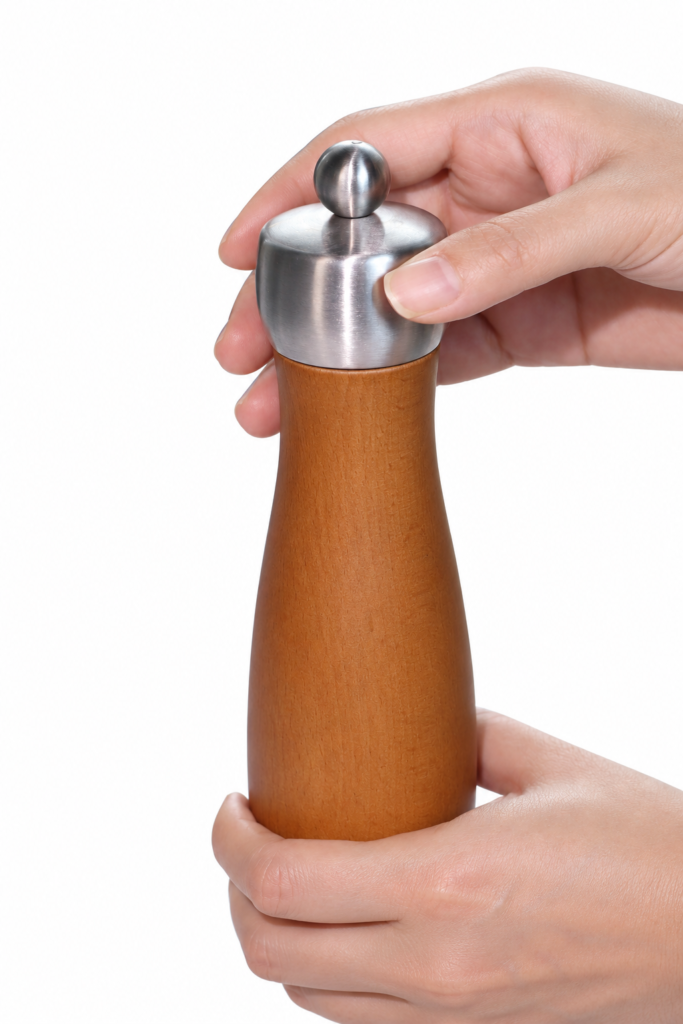
There is no single ideal pepper mill diameter.
A wider wooden body can provide good leverage, but it may be harder for smaller hands to hold securely. A narrower mill is easier to wrap the hand around, but it may require a firmer grip during grinding.
Body shape matters as well.
A slightly contoured body can provide a more natural holding point than a completely straight cylinder. Surface finish also changes the experience. A highly polished wooden surface may look more premium, while a matte or lightly textured finish can provide better grip.
The top knob deserves the same attention. A very small or smooth knob can concentrate pressure on the fingers, especially when the mechanism is set to a finer grind.
This is why we recommend evaluating the assembled sample rather than choosing a product from dimensions and photos alone.
Two wooden pepper mills with similar specifications can feel surprisingly different in the hand.
2. Grinding Mechanism Alignment and Construction
The grinding mechanism is another major source of turning resistance.
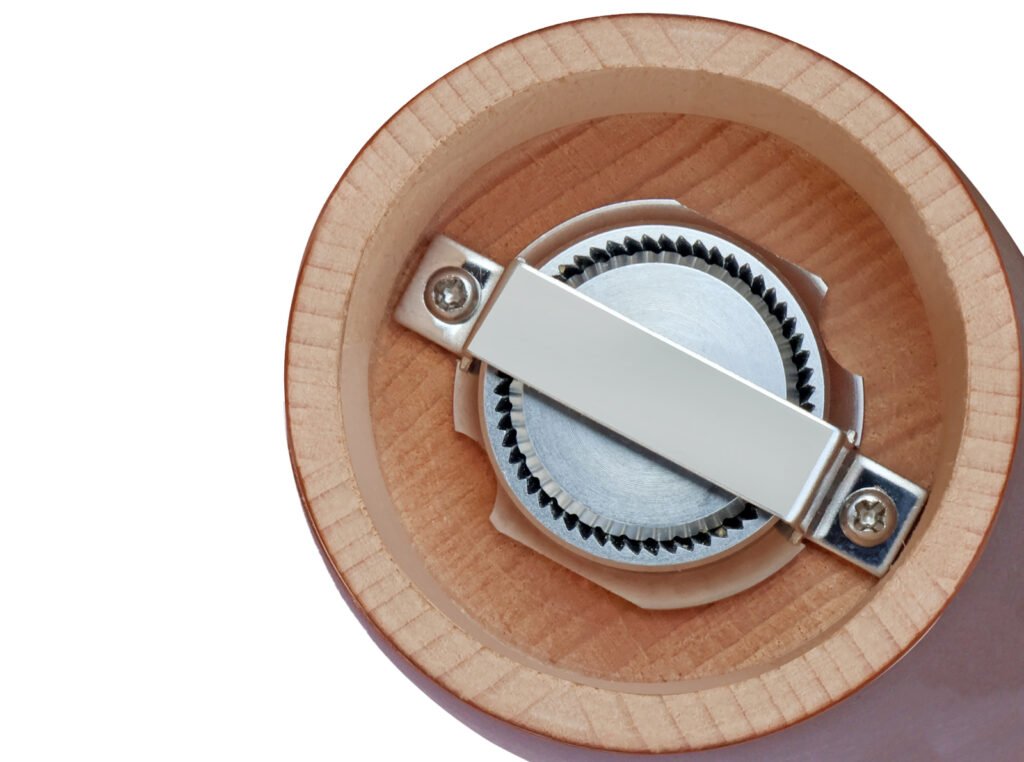
For the wooden products we source, pepper mills typically use a metal grinding mechanism, while salt mills use a ceramic mechanism. The appropriate mechanism depends on the intended product and application.
However, mechanism material alone should not be treated as a guarantee of performance.
Alignment and assembly matter too.
During rotation, resistance should feel reasonably consistent. Sudden catching, noticeable wobbling, or a large change in force at one point of the rotation deserves closer inspection.
An important sourcing detail is to test the mechanism under load.
An empty pepper mill can turn very smoothly because the grinding surfaces are doing almost no work. Once peppercorns enter the grinding chamber, the actual resistance becomes much easier to judge.
For more information about mechanism construction and material differences, read our guide to pepper mill mechanism design.
3. Fine vs. Coarse Grind Setting Resistance
A pepper mill should not be evaluated only at its loosest setting.
At a coarse setting, peppercorns generally pass through the grinding mechanism with less resistance. Tightening the adjustment for a finer grind normally increases the work required from the mechanism.
Some increase in turning resistance is therefore expected.
What matters is whether that increase remains reasonable and controlled.
When evaluating a sample, move through several grind settings and check whether:
- The adjustment is easy to operate.
- The setting remains in position during grinding.
- Resistance increases gradually rather than suddenly.
- The mechanism continues turning without locking or catching.
- The difference between coarse and fine settings is practical and usable.
A product specification may advertise multiple grind settings, but the number of settings means little if the adjustment is inconvenient or the finer settings are uncomfortable to use.
How to Test Pepper Mill Samples for Commercial Sourcing
When evaluating an easy to turn pepper mill for commercial sourcing, we recommend keeping the test simple and realistic.
Use actual peppercorns. If several models are being compared, use similar peppercorns and similar grind settings. This makes differences between samples easier to identify.
| Evaluation Point | How to Test | What to Look For |
|---|---|---|
| Starting resistance | Start grinding with peppercorns loaded | Smooth engagement without excessive starting force |
| Grip and finish | Hold and turn the mill naturally | Secure grip without needing to squeeze or constantly reposition the hand |
| Mechanism alignment | Make several complete rotations | Consistent resistance without obvious catching or wobbling |
| Coarse setting | Grind at a relatively coarse setting | Smooth feeding and controlled rotation |
| Fine setting | Tighten the adjustment and grind again | Reasonable increase in resistance without locking |
| Adjustment control | Move between coarse and fine | Adjustment remains stable and easy to operate |
| Repeated use | Grind repeatedly rather than just once | Comfort and control remain acceptable after multiple turns |
| Sample consistency | Compare multiple samples when available | Similar feel, assembly, adjustment, and mechanism behavior |
This does not require complicated laboratory equipment.
For many sourcing decisions, a careful hands-on comparison can reveal problems that are not visible in quotations, photos, or specification sheets.
It is also useful to record the results when several samples are being compared. This makes it easier to discuss specific issues with suppliers instead of relying on comments such as “this one feels better.”
Red Flags in Low-Cost Wholesale Pepper Mills
Price matters in any sourcing project. But when comparing very low quotations, it is worth checking where the cost difference comes from.
A lower price does not automatically mean poor quality. At the same time, buyers should pay closer attention when a sample shows:
- Uneven resistance during rotation
- Noticeable mechanism wobble
- A grind adjustment that easily moves out of position
- Poor fit between the mechanism and wooden body
- A slippery shape that is difficult to control
- Large differences between samples of the same model
These issues may come from different causes, so they should not automatically be treated as proof of a bad product. They are simply reasons to investigate further before confirming a larger order.
This is especially important when sourcing for retail or hospitality use, where the product may be handled repeatedly rather than occasionally.
For a broader discussion, see our guide to the warning signs of a low-cost pepper mill.
Why Sample Consistency Matters for B2B Buyers
For B2B sourcing, approving one easy to turn pepper mill sample is only the first step. Buyers also need to consider whether similar turning comfort can be maintained across the order.
The approved sample should represent the products that will eventually be supplied. This is why sample consistency matters for commercial buyers.
If possible, compare more than one sample of the same model. Look for differences in turning resistance, mechanism alignment, grind adjustment, wooden body finishing, and assembly.
For larger sourcing programs, these observations can also be turned into clearer product requirements before an order is placed.
Instead of asking only for “good quality,” buyers can discuss specific expectations such as mechanism type, surface finish, adjustment design, acceptable assembly, packaging, and sample approval.
This is one of the practical advantages of treating sample evaluation as part of the sourcing process rather than simply choosing the product that looks best.
If you are still comparing product styles, our wooden pepper mills page shows the type of wooden pepper and salt mills we focus on sourcing.
What Makes a Pepper Mill Easy to Turn?
In practical terms, an easy to turn pepper mill should combine a secure grip, consistent mechanism resistance, and a usable adjustment range.
The goal is not to find the mill with the least possible resistance. A mechanism may feel very light when empty or at a loose grind setting, but that does not show how it will perform with peppercorns during normal use.
For B2B buyers, realistic sample testing is therefore more useful than judging turning comfort from specifications alone. Test the mill with peppercorns, compare coarse and fine settings, and pay attention to whether the grip and turning resistance remain comfortable and consistent.
At PepperMillSourcing, we work as a sourcing and supply-chain partner rather than presenting ourselves as the factory. We help buyers compare wooden pepper and salt mill options, communicate product requirements with suppliers, coordinate samples, and follow sourcing projects through production and delivery.
If you are sourcing wooden pepper mills for retail, hospitality distribution, or private-label programs, contact us at info@peppermillsourcing.com with your target product, quantity, market, and customization requirements. We can help you evaluate suitable sourcing options.