
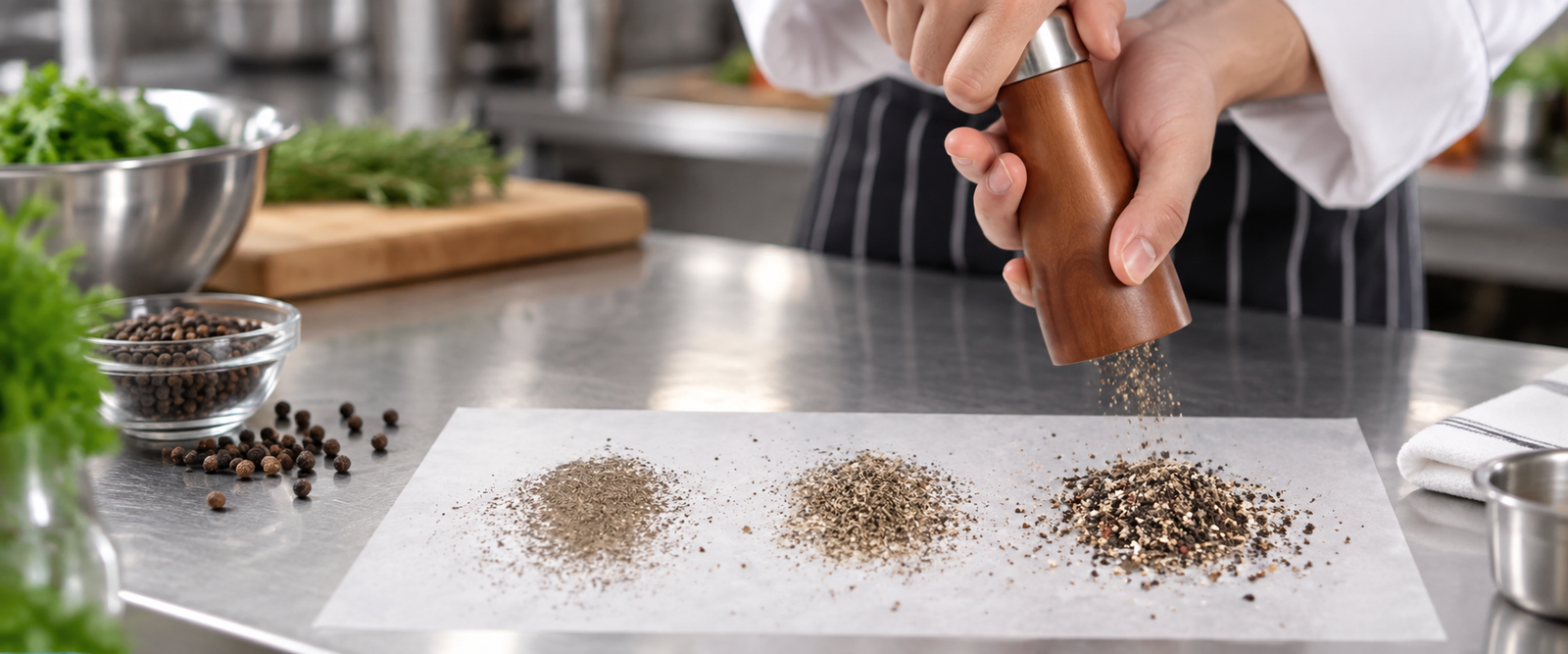

For foodservice distributors and hospitality buyers, choosing a pepper mill for restaurant prep requires more than comparing appearance, size, or price. The product will eventually be used in a working kitchen, where grind consistency, adjustment stability, grip, cleaning, and repeated use all affect the user experience.
Before adding a wooden pepper mill to a product line, buyers should evaluate how well it matches common restaurant tasks and whether different samples of the same model perform consistently.
B2B Buyer Summary: Focus first on grind control, setting stability, ergonomics, maintenance, and sample consistency. Once a model passes practical testing, compare MOQ, lead time, packaging, and private-label requirements before placing a larger order.
Match Grind Control to Restaurant Prep Tasks
Restaurants use different pepper textures for different dishes. Fine pepper may be preferred for sauces and dressings, medium grinds for general seasoning, and coarser pepper for steaks, salads, and finishing.
For B2B buyers, the goal is not simply to find a mill with the widest adjustment range. The more important question is whether the mill produces a suitable and repeatable result for its intended customers.
| Restaurant Application | Typical Grind Preference | What Buyers Should Evaluate |
|---|---|---|
| Sauces and dressings | Fine | Even output and adjustment control |
| General seasoning | Medium | Consistency during repeated use |
| Steaks and grilled foods | Medium to coarse | Setting stability and grinding resistance |
| Salads and finishing | Coarse | Visible texture and practical output |
These are practical examples rather than fixed rules. Sample testing should reflect the intended market and customer use.
Check Grind Adjustment and Setting Stability
An adjustable pepper mill is useful only when its setting works predictably.
During sample evaluation, check whether:
- The grind setting is easy to adjust
- The setting remains reasonably stable during repeated grinding
- A previous setting can be reproduced
- Different samples show similar adjustment behavior
The objective is usable and repeatable grind control, not simply a large number of adjustment positions.
Mechanism construction, shaft alignment, body fit, and final assembly can all influence how the adjustment performs in the finished mill.
Evaluate Ergonomics and Repeated Use
Body diameter, knob size, surface finish, and grinding resistance affect how a pepper mill feels during restaurant use.
These differences are difficult to judge from product photos or specifications alone. Buyers should test samples with actual peppercorns and use the same test conditions when comparing different models.
A visually attractive wooden pepper mill still needs to be comfortable and practical as a working kitchen tool.
Consider Cleaning, Durability, and Mechanism Design
Restaurant-use pepper mills are handled and cleaned more frequently than products used occasionally at home.
For wooden mills, the body should generally be wiped clean rather than soaked. Buyers should also check whether pepper residue can be removed easily, whether the adjustment area is accessible, and whether replacement mechanisms or parts are available if required.
The mechanism and wooden body should be evaluated as a complete product. Poor fit or alignment can affect adjustment and grinding even when the individual components appear acceptable.For a closer look at how the internal components affect grinding and maintenance, see our guide to pepper mill mechanism design.
For buyers comparing products mainly by price, it is also worth understanding the common problems in cheap pepper mills before evaluating a lower-cost option.
B2B Sample Testing Before Ordering
A structured sample test provides more useful information than judging a mill mainly by appearance.
- Use the same peppercorns for each sample.
- Test fine, medium, and coarse settings.
- Grind repeatedly at one setting to check stability.
- Change settings and return to a previous position.
- Evaluate grip, resistance, filling, and cleaning.
- Inspect the mechanism after repeated use.
- When possible, compare more than one unit of the same model.
For B2B sourcing, the final point is particularly useful. One sample can show whether the design is suitable, while several samples provide a better indication of unit-to-unit consistency.
This does not replace production QC, but it helps buyers decide whether a product is worth moving to the next purchasing stage.
B2B Sourcing Checklist for Restaurant Pepper Mills
Once a model passes sample testing, commercial requirements should also be reviewed.
| Evaluation Area | What to Check |
|---|---|
| Grind control | Suitable for intended restaurant applications |
| Adjustment stability | Consistent during repeated use |
| Sample consistency | Similar behavior across samples |
| Construction | Proper body and mechanism fit |
| Maintenance | Practical cleaning and part accessibility |
| MOQ | Suitable for the purchasing plan |
| Lead time | Compatible with replenishment needs |
| Private label | Available logo, packaging, finish, or other options |
| Documentation | Relevant specifications and compliance information |
Not every project requires customization. For many buyers, an existing model that already meets the required quality, appearance, and price positioning is a simpler starting point.
Choosing a Pepper Mill for Restaurant Prep and Foodservice
For restaurant users, a suitable pepper mill should provide predictable grinding, comfortable operation, and practical maintenance.
For distributors and hospitality buyers, the sourcing decision also includes sample consistency, construction, pricing, MOQ, lead time, and branding requirements.
PepperMillSourcing focuses on a limited range of wooden pepper and salt mills rather than offering a large catalog of similar designs. Buyers can first review our existing models and order samples to evaluate their suitability.
If an existing model meets your requirements, we can discuss pricing, quantity, packaging, and private-label options. If you need a different design or specification, send us your detailed requirements so we can review suitable sourcing and production options with our suppliers.
For B2B inquiries, contact info@peppermillsourcing.com with your target product, estimated quantity, market, and any customization requirements.