
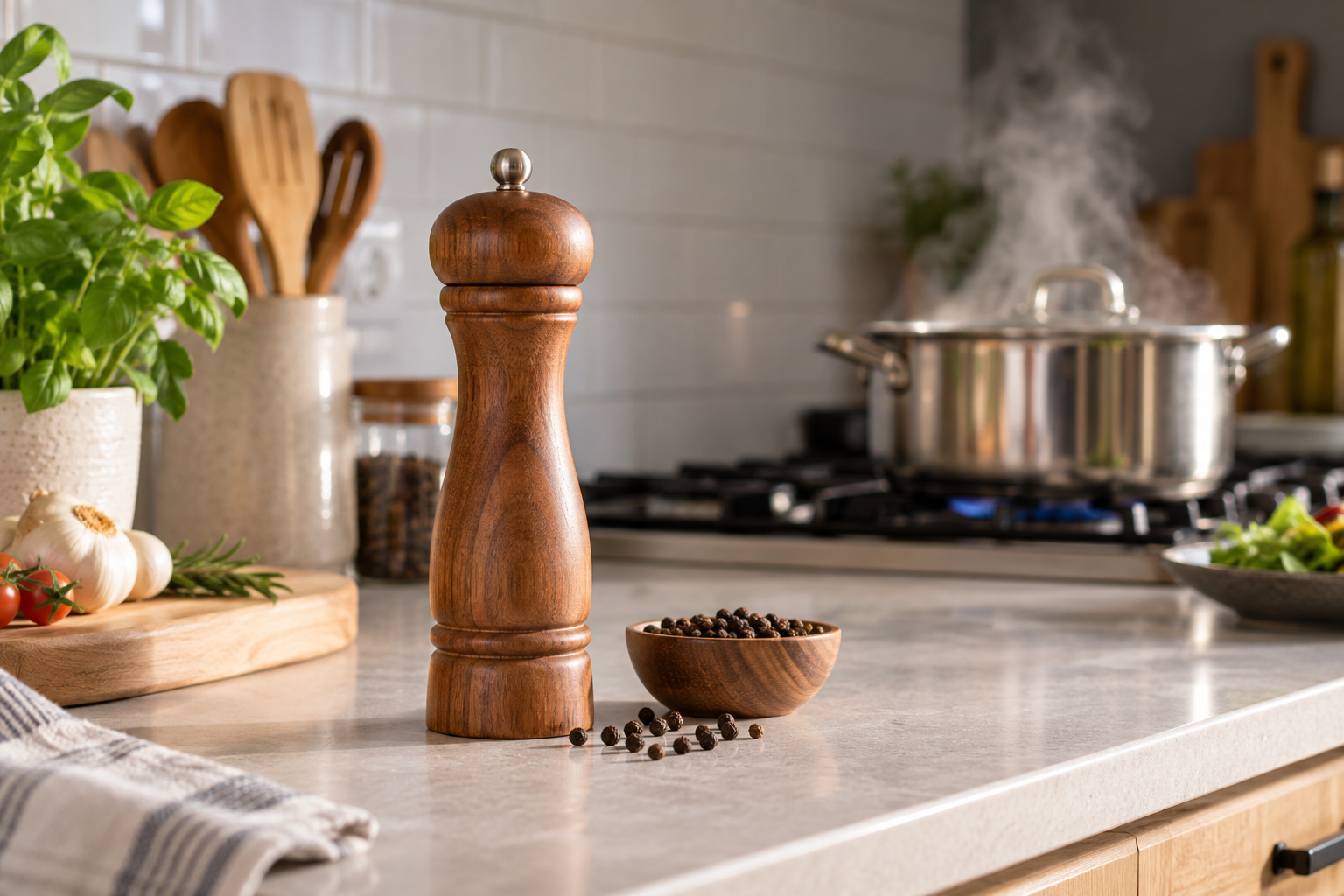

Pepper mill storage is easy to overlook when evaluating a product. In humid kitchens, cooking steam, wet hands, condensation, or damp peppercorns can contribute to peppercorn clumping, residue buildup, and increased grinding resistance.
For importers, retailers, hospitality suppliers, and private-label buyers, moisture therefore matters from two directions: how the end user stores the mill and how well the product is finished and assembled.
Quick Summary for Sourcing Managers
Keep pepper mills away from direct steam and refill them with dry peppercorns. During sample evaluation, buyers should also check the wood finish, mechanism fit, refill design, maintenance access, and consistency between samples.
How Humidity Affects Pepper Mill Performance
Peppercorn Clumping and Grinding Resistance
Damp peppercorns may stick together and feed less consistently into the grinding chamber. Fine pepper particles and natural oils can also leave residue around the mechanism, which may become more difficult to clear in humid conditions.
Common warning signs include:
- Increased turning resistance
- Inconsistent peppercorn feeding
- Reduced grinding output
- Rough or uneven rotation
- Damp or clumped peppercorns
These symptoms do not automatically mean the mechanism has failed. Check the peppercorns, storage conditions, grind adjustment, and visible residue first.
Moisture, Wooden Bodies, and Surface Finishes
For a wooden pepper mill, the exterior finish affects more than appearance. During sample evaluation, check whether the finish is even around the body, edges, openings, and areas where the mechanism meets the wood.
Do not assume that a particular finish makes a wooden pepper mill waterproof. Unless a supplier provides supporting performance data, repeated contact with water, concentrated steam, and condensation is best avoided.
Best Pepper Mill Storage Practices in Humid Kitchens
Keep Away from Direct Steam and Condensation
A pepper mill does not need to be hidden in a cabinet. A countertop is fine if it stays reasonably dry.
Avoid storing the mill:
- Directly beside or above a stove
- Above a kettle or other steam-producing appliance
- Immediately beside a sink or dishwasher
- Beside a window where condensation regularly forms
The goal is not to avoid normal kitchen humidity, but to reduce repeated exposure to concentrated moisture.
Keep Peppercorns Dry When Refilling
Store whole peppercorns in a closed container in a dry place. Refill the mill with dry hands, a dry spoon, or a clean dry funnel.
If peppercorns are noticeably damp, sticky, or clumped, replace them rather than forcing them through the mechanism.
Pre-ground pepper or salt should not be placed in a pepper mill unless the product is specifically designed for it. Flavored or oil-treated peppercorns may also leave more residue depending on their ingredients and the mechanism design.
Keep Cleaning Simple
For routine maintenance, use a dry cloth on the exterior and a soft dry brush for accessible residue around the mechanism, following the supplier’s care instructions.
If moisture gets inside, empty the mill and allow it to dry naturally in a ventilated place away from direct high heat. Refill only when both the mill and peppercorns are dry.
Avoid unnecessary disassembly, as different mechanisms have different internal constructions. For more detail, see our guide to [pepper mill mechanism design] .
Moisture Problem or Mechanical Problem?
If a pepper mill becomes stiff after exposure to steam or damp peppercorns, dry it first and test again with fresh, dry peppercorns.
If turning resistance remains unusually high, moisture may not be the cause. Check mechanism alignment, adjustment, component fit, wear, or obstruction in the grinding path.
For sourcing buyers, recurring problems across several new samples are more meaningful than a problem with one poorly stored mill. This is why comparing several samples under similar conditions is useful.
For other product-quality issues, see our guide to [common problems in cheap pepper mills] .
B2B Sample Checklist: Evaluating Moisture-Related Design Risks
Specifications and quotations cannot show every detail of an assembled pepper mill. Physical samples are more useful for checking practical build quality and maintenance.
| Inspection Point | What to Check | Why It Matters |
|---|---|---|
| Wood finish | Even finish around edges, openings, and transitions | Inconsistent areas deserve review before approval |
| Reservoir opening | Easy to refill and clear | Reduces areas where residue is difficult to remove |
| Mechanism installation | No obvious looseness or misalignment | Poor assembly can affect grinding and maintenance |
| Grinding test | Grind dry peppercorns through several rotations | Reveals catching or unusual resistance |
| Adjustment | Test normal coarse and fine settings | Resistance should change predictably |
| Cleaning access | Inspect accessible mechanism areas | Routine residue should be manageable |
| Multiple samples | Compare fit, finish, and turning resistance | One sample cannot establish order consistency |
These checks evaluate build quality and maintainability; they do not prove moisture resistance.
If a supplier makes specific claims about coatings, corrosion resistance, food-contact materials, or high-humidity performance, ask for relevant specifications or supporting documentation.
You can also review our [wooden pepper mills] when comparing product styles for a sourcing project.
Storage Habits and Product Quality Both Matter
Good pepper mill storage is simple: avoid direct steam and condensation, use dry peppercorns, and allow the mill to dry naturally if moisture gets inside.
For B2B buyers, storage is only part of the picture. Finish quality, mechanism installation, adjustment, maintenance access, and consistency between samples should also be considered before approving a product.
At PepperMillSourcing, we work as a sourcing and supply-chain partner rather than as the manufacturer. We help buyers compare wooden pepper and salt mill options, coordinate samples, communicate requirements with suppliers, and follow sourcing projects through production and delivery.
If you are sourcing wooden pepper mills for retail, hospitality, or private-label programs, contact us at info@peppermillsourcing.com with your target product, quantity, market, and customization requirements.