
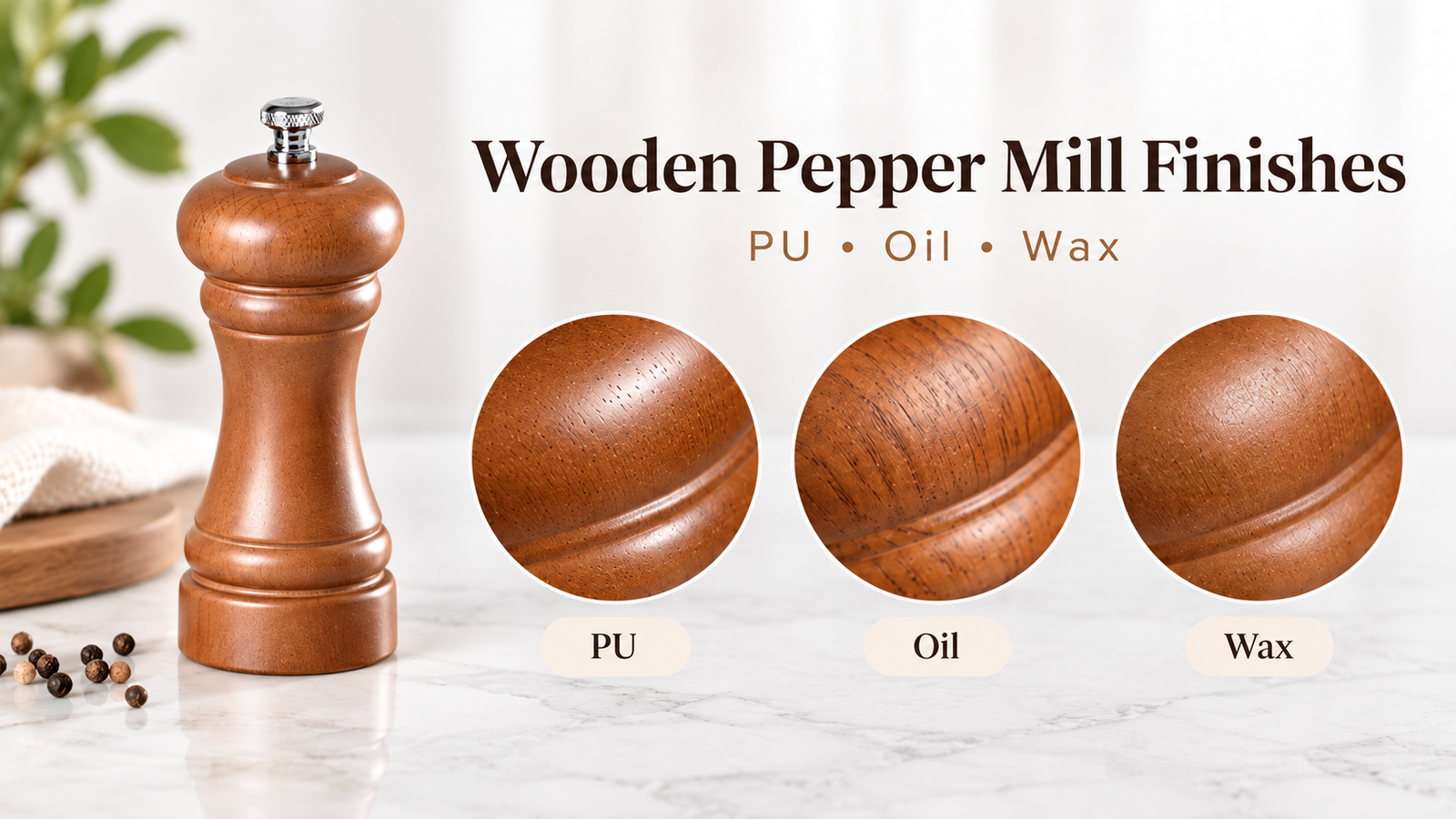

Most B2B buyers spend plenty of time comparing grinding mechanisms, but much less time evaluating wooden pepper mill finishes. That can be a mistake.
That can be a mistake.
The finish affects how a pepper mill handles humidity, sea freight, warehouse storage, kitchen grease, repeated handling, and long-term use. A poor finish may lead to uneven appearance, surface wear, stickiness, staining, or customer complaints after the product has already reached the market.
For importers, retailers, distributors, and private-label buyers, the finish should therefore be treated as part of the product specification—not simply as a cosmetic detail.
This guide compares the most common wooden pepper mill finishes and explains which options are better suited to different B2B sourcing needs.
Why Wooden Pepper Mill Finishes Matter
Wood is naturally porous.
Without suitable treatment, the exterior can absorb moisture, stains, grease, and fingerprints. Changes in humidity can also affect its appearance over time.
A good finish helps improve:
- moisture resistance;
- stain resistance;
- surface durability;
- cleaning performance;
- appearance consistency; and
- stability during storage and shipping.
For mass production, consistency is especially important.
A finish that looks good on one sample must also perform consistently across hundreds or thousands of units.
Exterior Finish and Food-Contact Surfaces Are Different
The outside and inside of a pepper mill do not always need the same treatment.
The exterior mainly needs protection from handling, moisture, stains, and wear.
The internal spice chamber directly holds peppercorns, coarse salt, or other dry spices.
For the wooden mills we currently source and recommend, the standard construction is:
Exterior: PU coating for durability, moisture resistance, and consistent appearance.
Interior spice chamber: Uncoated wood, with no applied PU coating on the wooden surface that directly holds peppercorns or coarse salt.
This allows each part of the product to use the finish most suitable for its function.
PU Coating for Wooden Pepper Mills
PU stands for polyurethane.
Unlike an oil finish, PU forms a cured protective film on the wood surface.
It is widely used on commercially produced wooden products because it offers a practical balance of durability, appearance, and production consistency.
Typical advantages include:
- good moisture resistance;
- good stain resistance;
- resistance to repeated handling;
- consistent matte, satin, or gloss finishes;
- flexible color options;
- low maintenance; and
- good suitability for mass production.
Best For
PU coating is especially suitable for:
- high-volume retail programs;
- private-label orders;
- hospitality supply;
- online retail;
- buyers who want low maintenance; and
- products where appearance consistency is important.
You can see how this type of finish is used on the commercial wooden pepper grinders we currently source for restaurant, wholesale, and private-label programs.
For export orders, this consistency matters because the product may pass through factories, warehouses, sea freight, distributors, and retail storage before reaching the end user.
A properly controlled PU finish usually provides better exterior protection than an oil-only finish.
Food-Grade Mineral Oil
Food-grade mineral oil works differently.
Instead of forming a hard film, it penetrates into the wood.
Its main advantages are:
- low odor;
- very low risk of rancidity;
- natural wood feel;
- simple application; and
- easy reapplication.
Mineral oil is commonly used on cutting boards, wooden utensils, and similar products.
Best For
Mineral oil is suitable for products that prioritize:
- natural wood texture;
- simple oil treatment;
- rustic positioning; and
- a surface that can be periodically maintained.
The trade-off is that it generally provides less protection against stains, moisture, and wear than PU coating.
It may also require re-oiling during long-term use.
Plant-Oil Finishes
Plant-based oils can sound more natural, but not every plant oil is suitable for wooden products.
Ordinary cooking oils may oxidize over time and can sometimes cause:
- unpleasant odor;
- rancidity;
- sticky surfaces; or
- uneven appearance.
Certain drying oils, such as formulations based on tung oil or linseed oil, are more suitable for wood finishing because they cure differently.
However, buyers should still ask what the complete finish contains.
A commercial “plant-based finish” may include oils, waxes, resins, solvents, drying agents, or other additives.
Best For
Plant-oil systems are most suitable for brands that strongly value plant-derived material positioning and are willing to verify:
- curing performance;
- storage stability;
- odor;
- batch consistency; and
- compliance.
“Natural” should be treated as a product-positioning feature, not as proof that a finish is automatically safer or better.
Beeswax and Oil-Wax Finishes
Beeswax is often used together with oil rather than as a standalone finish.
An oil-wax system can provide:
- a natural appearance;
- pleasant hand feel;
- moderate water resistance; and
- premium or artisanal positioning.
Best For
Oil-wax or beeswax finishes work well for:
- boutique brands;
- premium gift collections;
- lifestyle products; and
- buyers who value tactile feel and natural appearance.
The disadvantage is that production can be more labor-intensive because the finish may require heating, blending, application, polishing, and additional quality control.
PU vs. Mineral Oil vs. Plant Oil vs. Beeswax
| Factor | PU Coating | Mineral Oil | Plant-Oil Finish | Oil + Beeswax |
|---|---|---|---|---|
| Moisture resistance | High | Moderate | Varies | Moderate–Good |
| Stain resistance | High | Moderate | Varies | Moderate |
| Wear resistance | Good | Lower | Varies | Moderate |
| Batch consistency | High | High | Depends on system | Moderate |
| Maintenance | Low | Re-oiling may be needed | Depends on system | Re-waxing may be needed |
| Natural wood feel | Moderate | High | High | High |
| Mass-production suitability | High | High | Depends on system | Medium |
Quick Sourcing Guide
For high-volume retail and private-label programs, PU is usually the most practical choice because of its consistency, durability, and low maintenance.
For natural or rustic product lines, mineral oil may be more suitable.
For plant-based positioning, a properly formulated plant-oil system can work well.
For premium boutique products, oil-wax or beeswax finishes can provide stronger tactile and storytelling value.
Not sure which finish suits your market?
We can arrange physical samples so you can compare surface feel, appearance, grinding performance, and overall construction before confirming a bulk order.→ Request Samples
Our Recommended Construction
PepperMillSourcing works as a pepper mill sourcing partner rather than presenting itself as the manufacturer of every product we recommend.
For the wooden pepper and salt mills we currently recommend, our partner suppliers typically use:
Exterior
PU coating
This provides:
- moisture resistance;
- stain resistance;
- stable appearance;
- better handling durability; and
- low maintenance.
Interior Spice Chamber
Uncoated wood
The PU coating is not applied to the wooden area that directly holds peppercorns or coarse salt.
For salt-specific applications, our wooden salt grinders use ceramic grinding mechanisms designed for corrosion resistance and commercial use.
This construction separates exterior protection from direct spice-contact surfaces.
Alternative finishes can also be discussed for OEM or private-label projects, depending on the product, order quantity, and testing requirements.
FDA, LFGB and Third-Party Testing
For B2B sourcing, actual testing is more useful than broad claims such as “non-toxic” or “food safe.”
The wooden pepper and salt mills we currently recommend have passed relevant FDA- and LFGB-related testing, and supporting documentation is available for buyers who need it.
For European markets, food-contact materials are generally covered by Regulation (EC) No 1935/2004, while LFGB requirements are commonly referenced for the German market.
For U.S. projects, the applicable requirements depend on the specific material, intended use, and testing scope.
The practical point for buyers is simple:
Check the test report for the actual product you plan to buy.
If your company or retailer requires additional testing, we can also help coordinate testing through a buyer-specified third-party laboratory such as SGS, Intertek, TÜV, Bureau Veritas, or another qualified testing organization.
Need FDA- or LFGB-related documentation?
Ask us for the available reports or let us know which testing standard your market requires.For common questions about samples, OEM/ODM customization, MOQ, LFGB documentation, lead times, and international shipping, see our Pepper Mill & Salt Grinder FAQ
8 Questions to Ask Before Ordering
Before approving a wooden pepper mill supplier, ask:
1. What finish is used?
PU, mineral oil, plant oil, wax, lacquer, or another system?
2. Which parts are coated?
Confirm the exterior and internal spice-contact surfaces separately.
3. Is the spice chamber coated?
Do not assume that the inside uses the same finish as the outside.
4. How is the finish cured?
Application and curing affect final performance.
5. What test reports are available?
Check the product, tested material, laboratory, date, method, and result.
6. Can additional testing be arranged?
Important for retailers, importers, and private-label buyers with their own compliance requirements.
7. Can the finish be customized?
Options may include color, gloss level, PU, oil, wax, or another approved finish system.
8. How is the surface protected during shipping?
Poor packaging can still cause scratches, rubbing marks, or moisture-related damage even when the finish itself is good.
Which Finish Is Right for Your Market?
There is no single finish that is best for every wooden pepper mill.
Choose based on the commercial goal.
Choose PU When You Need
- high consistency;
- strong exterior protection;
- low maintenance;
- mass-production efficiency; and
- stable retail appearance.
Choose Mineral Oil When You Need
- natural wood feel;
- simple oil treatment; and
- a product where periodic maintenance is acceptable.
Choose Plant Oil When You Need
- plant-based positioning;
- natural-material storytelling; and
- a finish system that has been properly validated.
Choose Oil-Wax When You Need
- premium tactile feel;
- boutique positioning; and
- a stronger natural or artisanal appearance.
For many commercial wooden pepper mill programs, PU coating on the exterior offers the most practical balance of durability, consistency, and low maintenance.
Ready to Source Your Next Wooden Pepper Mill?
A complete sourcing specification should consider more than just the grinding mechanism.
Buyers should review:
wood + finish + spice-contact surfaces + mechanism + testing + packaging
PepperMillSourcing helps importers, retailers, distributors, and private-label buyers:
- compare available wooden pepper and salt mills;
- evaluate finish options through physical samples;
- review available FDA- and LFGB-related test reports;
- arrange buyer-specified third-party testing;
- customize finish, color, branding, and packaging; and
- coordinate production and export preparation.
→ Request a Physical Sample
→ Ask for FDA / LFGB Test Documentation
Frequently Asked Questions
Is PU coating suitable for wooden pepper mills?
Yes, PU can be a practical exterior finish because it provides durability, moisture resistance, stain resistance, and consistent appearance. Suitability should still be evaluated based on the actual coating, application, curing, and test results.
Is the inside of a wooden pepper mill coated?
It depends on the product. For the wooden mills we currently recommend, the exterior uses PU coating while the internal wooden spice chamber is left uncoated.
Is mineral oil better than PU?
Not necessarily. Mineral oil provides a more natural wood feel but may require more maintenance. PU generally provides stronger exterior protection and better mass-production consistency.
Are plant-oil finishes safer because they are natural?
Not automatically. The complete formulation, curing, storage stability, and test results are more important than whether the finish is described as natural.
Can buyers request additional testing?
Yes. Additional third-party testing can be arranged according to the buyer’s market, internal requirements, or nominated testing laboratory.
Can the finish be customized?
In many cases, yes. Color, gloss level, coating type, branding, and packaging can be discussed for OEM or private-label orders, subject to sampling and production feasibility.