
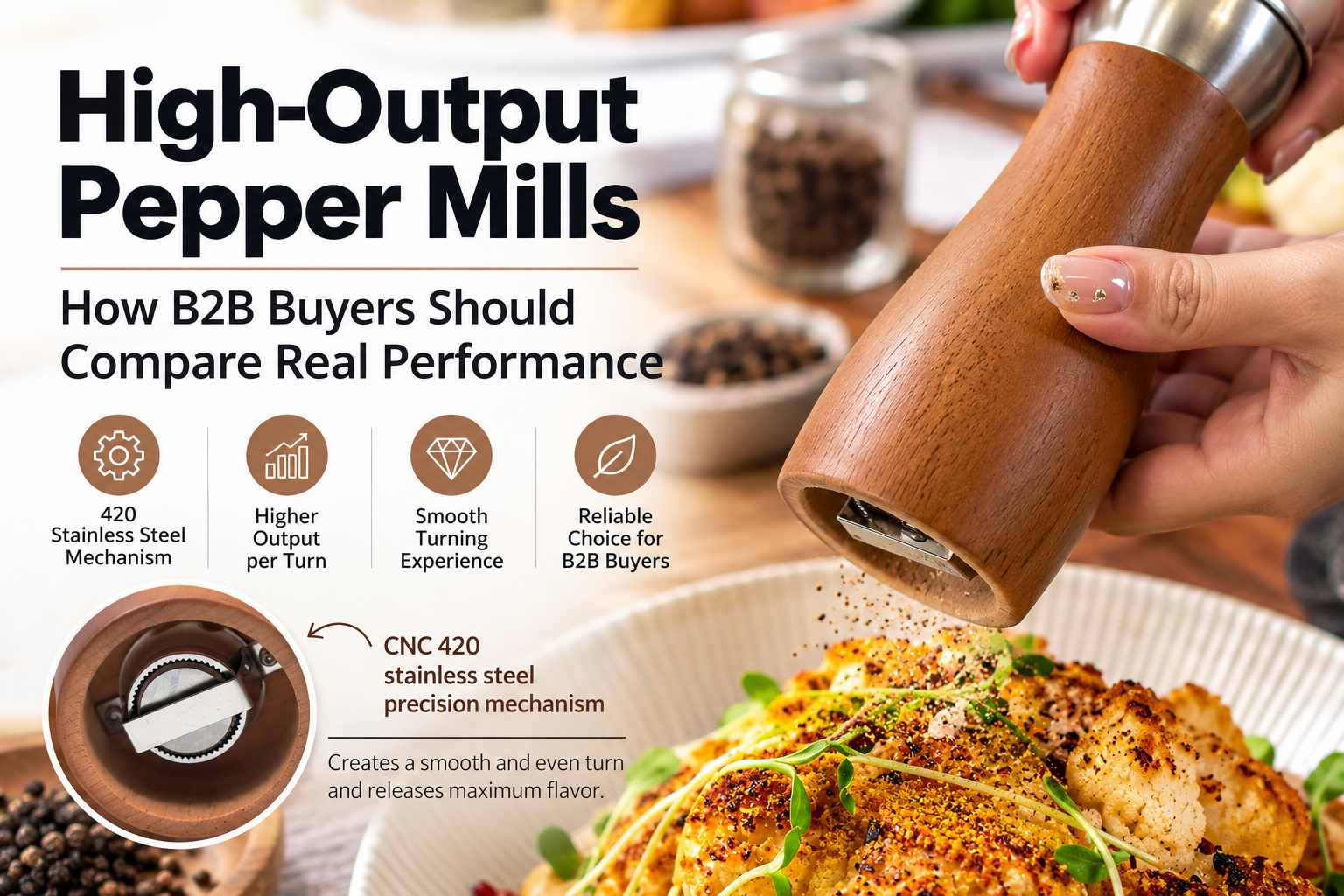

If you are sourcing a high output pepper mill, a large pile of pepper in a product demonstration does not tell you enough. What matters is whether the mill produces the grind you need efficiently, with reasonable turning effort and a stable adjustment.
The grinding mechanism is central to performance, but buyers should also consider how the complete mill works during repeated use. The drive system, grip, adjustment, grind setting, and peppercorns used for testing can all affect real-world performance.
For B2B buyers, the more useful question is:
Which mill produces more usable ground pepper at a comparable grind size while remaining comfortable and consistent to operate?
Quick Answer for B2B Buyers
Compare high-output pepper mills at a similar grind size using the same peppercorns and consistent test conditions. Check the grinding mechanism first, then evaluate drive stability, grip, turning effort, and adjustment stability. Output per turn matters, but practical grinding speed also depends on how comfortably and consistently the complete mill can be operated.
What Does “High Output” Mean for a Pepper Mill?
It helps to separate mechanical output from practical output:
- Mechanical output is the amount of ground pepper produced over a defined number of rotations under comparable test conditions.
- Practical output is how efficiently a person can produce the pepper they need during actual use.
The two are related, but they are not identical.
A mill may produce more pepper per complete rotation but require greater turning effort. Another may produce slightly less per turn but allow the user to maintain a faster and more comfortable grinding rhythm.
A useful comparison should therefore consider:
- Grind size
- Output per rotation
- Turning effort
- Grip
- Adjustment stability
- Repeatability
Note: Reservoir capacity is a separate specification. A larger reservoir holds more peppercorns, but it does not by itself mean higher output.
Why Does the Grinding Mechanism Matter Most?
The grinding mechanism is the key component to examine when evaluating a high-output pepper mill.
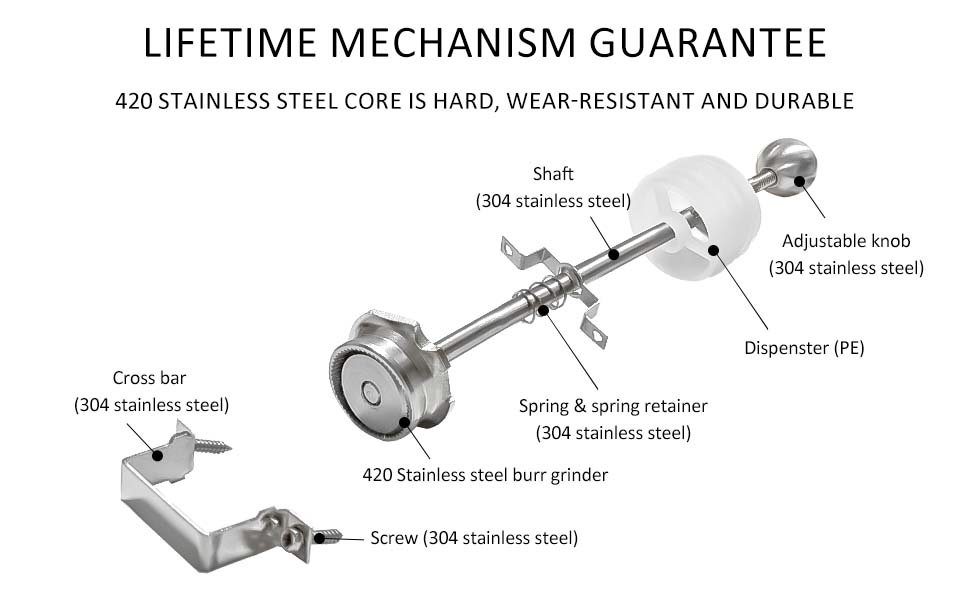
Our current wooden pepper mill model uses a 420 stainless steel grinding mechanism, while the grinding plate and several associated metal components use 304 stainless steel. This matters because high-output performance starts with a grinding system capable of processing peppercorns repeatedly and transferring the user’s turning action into effective grinding.
However, material alone does not prove high output.
The internal design of the mechanism also matters. Unless details such as tooth geometry, feeding design, and mechanism dimensions have been verified for a particular model, buyers should not assume that a larger mechanism or more aggressive-looking teeth automatically produce more pepper.
For sourcing purposes, use the material specification to understand what is inside the mill, then use the physical sample to verify how the complete grinding system actually performs.
What Role Does the Drive System Play?
The grinding mechanism does not operate independently. Turning force has to be transferred through the internal drive system.
Our current wooden pepper mill uses a 304 stainless steel drive rod, while the grinding mechanism itself is made from 420 stainless steel.
The drive rod should not be treated as the component that directly determines grams of pepper produced per rotation. Its more relevant roles include force transfer, stability, wear resistance, and consistent operation during repeated grinding.
This distinction matters because two wooden mills can look almost identical externally while using different internal constructions. The body shape, wood species, and external finish may tell you little about what is happening inside the mill.
For a B2B buyer, it is therefore useful to ask:
What materials are used in the grinding mechanism and drive system, and how does the assembled sample perform under repeated use?
Why Do Grip and Turning Design Matter?
Grip mainly affects practical output, rather than mechanical output per rotation. Even an efficient grinding mechanism still has to be operated by hand.
The upper section of the mill should therefore provide a comfortable and secure area for turning. If it is difficult to grip, slips easily, or requires frequent repositioning of the hand, the user may not be able to maintain an efficient grinding rhythm.
During sample evaluation, check whether the turning section:
- Fits the hand comfortably
- Provides a secure grip
- Can be turned naturally
- Requires excessive force
- Requires frequent regripping
- Allows a steady rhythm during repeated grinding
This becomes particularly relevant when more pepper needs to be ground at one time. A mill can perform well mechanically but still feel slow in practice if the user struggles to apply the required turning force comfortably.
(For more detail on this part of product evaluation, see our guide to choosing an easy-to-turn pepper mill.)
Why Does the Adjustment System Matter?
On this style of traditional wooden pepper mill, the top screw and nut are part of the adjustment system. For our current wooden pepper mill model, these components are 304 stainless steel.
The adjustment should be easy to operate, but it should also remain stable while the mill is being turned.
During sample testing, check whether it is:
- Smooth to adjust
- Easy to control
- Stable during repeated grinding
- Able to maintain the intended grind setting
This is important because grind size directly affects output comparisons. If the setting shifts during grinding, part of the pepper may be ground more coarsely or finely than intended. The output figure then becomes difficult to compare fairly with another sample.
Adjustment stability does not create high output by itself. Instead, it helps the grinding system maintain a consistent working condition.
Pepper Mills and Coarse Salt Mills Use Different Grinding Systems
High output is not limited to pepper mills. Coarse salt mills also need efficient grinding, but peppercorns and coarse salt should not automatically be treated as the same application.
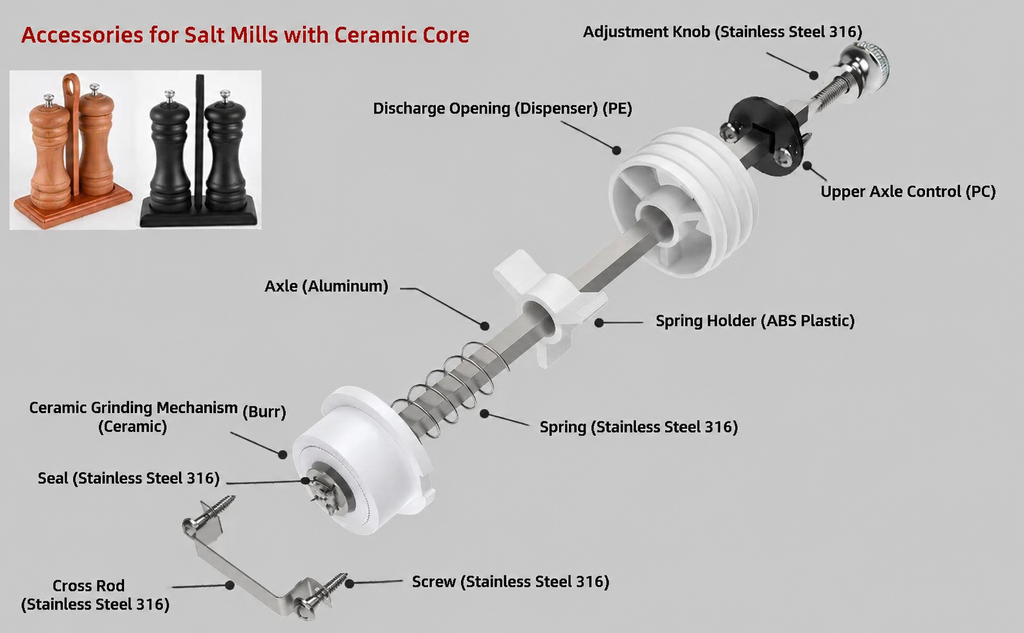
Our current wooden pepper and coarse salt mill models illustrate this difference:
| Component | Pepper Mill | Coarse Salt Mill |
|---|---|---|
| Wooden Body | Beech | Beech |
| Grinding Mechanism | 420 Stainless Steel | Ceramic |
| Grinding Plate | 304 Stainless Steel | 316 Stainless Steel |
| Screw | 304 Stainless Steel | 316 Stainless Steel |
| Nut | 304 Stainless Steel | 316 Stainless Steel |
| Top Cap | 304 Stainless Steel | 316 Stainless Steel |
| Drive Rod | 304 Stainless Steel | Aluminum |
| Surface Finish | Pigmented PU Paint | Pigmented PU Paint |
The important sourcing lesson is not that one material combination is universally better than another. It is that pepper and coarse salt mills can use different internal constructions for their intended ingredients.
Our pepper mill uses a stainless steel grinding mechanism, while our coarse salt mill uses a ceramic grinding mechanism. Buyers should therefore evaluate each mill using the ingredient it is designed to process.
Note: The drive rod in our coarse salt mill is aluminum, per the product material specification. Surface treatment and corrosion performance should be confirmed with us for your intended application.
Materials Matter, but Specifications Still Need Verification
Our current model uses a beech wood body with a pigmented PU-painted exterior. The brown and black versions use different paint colors rather than different wood species.
According to the product specification for this model, the exterior paint is non-toxic, and the model has undergone FDA-related food-contact testing.
For a B2B order, however, food-contact or regulatory requirements should be confirmed against the applicable documentation for the exact product and market involved. This becomes especially important when materials, finishes, components, or other specifications are changed through customization.
How Do You Test Pepper Mill Output?
When comparing a high output pepper mill, the next step is to test actual performance. A useful B2B comparison does not require a complicated laboratory setup. What matters is keeping the test conditions reasonably consistent.
Step 1: Match the Grind Size
Always compare the finished grind before comparing output. A coarse grind and a fine grind do not represent the same grinding task. A mill producing larger fragments may appear to have higher output simply because less grinding is required.
Use peppercorns from the same batch and similar fill levels. Grind a small amount from each sample onto a light-colored plate and compare the texture. Adjust the samples until the results are reasonably similar.
Tip: If your target application regularly uses both fine and coarse settings, test both.
Step 2: Measure Output per Rotation
- Place an empty collection dish on a suitable scale and tare it.
- Choose a defined number of complete rotations, grind the pepper, and record the collected weight.
- Calculate: Output per rotation = collected pepper weight ÷ total rotations
- Repeat the test several times rather than relying on a single run.
Use a simple record table:
| Sample | Grind Setting | Rotations | Ground Weight | Output / Rotation | Turning Effort | Setting Stable? |
|---|---|---|---|---|---|---|
| Sample A | Medium | 20 | ___ g | ___ g/turn | Easy / Moderate / Heavy | Yes / No |
| Sample B | Medium | 20 | ___ g | ___ g/turn | Easy / Moderate / Heavy | Yes / No |
| Sample C | Medium | 20 | ___ g | ___ g/turn | Easy / Moderate / Heavy | Yes / No |
Testing Note: Keep the peppercorns, grind texture, fill level, and definition of a complete rotation as consistent as reasonably possible. The purpose is not to create a universal industry benchmark, but to compare the actual samples being considered for your project.
Step 3: Test a Realistic Grinding Task
Output per rotation tells only part of the story. Choose an amount of pepper representative of the intended use and measure how long each mill takes to produce it at a comfortable pace.
Record:
- Total grinding time
- Slipping or regripping
- Uncomfortable resistance
- Adjustment changes
- Obvious changes in grind texture
This connects mechanical output with practical output. A buyer sourcing mills for frequent food preparation may place more emphasis on sustained grinding performance than a buyer selecting a mill primarily for occasional tabletop seasoning.For buyers evaluating mills for higher-volume kitchen use, see our guide to choosing a pepper mill for restaurant prep.
What Should B2B Buyers Ask About a High-Output Claim?
When a supplier describes a pepper mill as “high output,” the claim becomes more meaningful when the test conditions are clear.
Before approving a sample, ask:
- Grind size: At what grind setting was output evaluated?
- Peppercorns: What peppercorns were used?
- Rotation: What counted as one complete turn?
- Measurement: Was output measured by weight or judged visually?
- Internal construction: What materials are used for the grinding mechanism and drive system?
- Adjustment: Did the selected setting remain stable during repeated grinding?
- Repeatability: Was the test repeated, and were the results reasonably consistent?
A large pile of pepper in a demonstration may look convincing, but it does not provide these comparison conditions. Likewise, premium wood, stainless steel components, or a higher price do not independently prove high output.
The material specification tells you what you are buying. Sample testing tells you how that particular mill performs.
Compare the Complete Pepper Mill, Not One Specification
A high-output pepper mill should be evaluated as a complete product. A useful way to separate the different roles is:
- Grinding mechanism → core grinding performance
- Drive system → force transfer and repeated-use stability
- Grip → practical turning efficiency
- Adjustment → grind-setting consistency
- Sample testing → verified performance of the assembled mill
This avoids attributing high output to one material or component without testing the finished product.
The goal is not simply to find the mill that creates the largest pile of pepper. It is to find a mill that produces the required grind efficiently, consistently, and with manageable turning effort.
Test the Sample Before You Commit to a Larger Order
At PepperMillSourcing, we work as a sourcing and supply-chain partner for wooden pepper and salt mills.
For our current models, we can provide detailed material information rather than relying only on appearance or generic product descriptions. We also have existing product models available for buyers to evaluate, while customization can be coordinated with our partner factories when required.
If grinding output matters to your project, use the sample stage to verify it.You can also review our wooden pepper grinders before selecting models for sample evaluation.
When contacting us, tell us your intended ingredient, preferred grind range, usage scenario, estimated quantity, and any size, wood, color, branding, or packaging requirements. We can help you identify suitable existing models, arrange samples for evaluation, and discuss customization requirements before a larger order.