
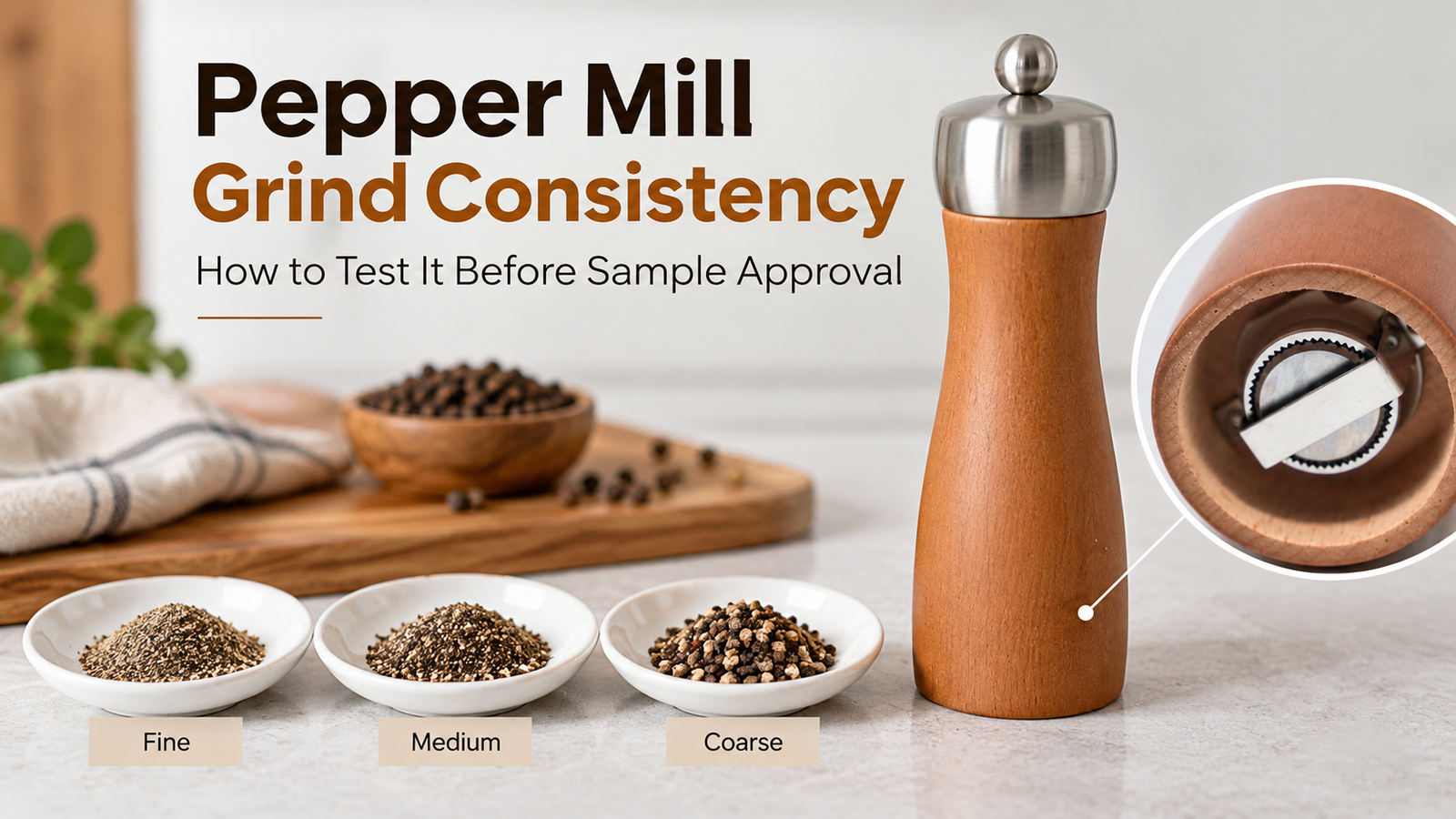

For commercial buyers, pepper mill grind consistency is more than a user preference. It is part of sample approval.
A mill may look well made and feel smooth in hand, but buyers still need to know whether the grind setting stays reasonably stable during repeated use and whether a preferred setting can be reproduced after adjustment.
This matters for restaurants, hospitality suppliers, distributors, private-label brands, and OEM projects, where a grinder may be used frequently and by different users.
PepperMillSourcing focuses on commercial-quality wooden grinders. Our existing grinding systems have already been used in the domestic commercial market in China and have shown stable performance through long-term practical use.
That is why we are comfortable encouraging buyers to request samples and test the products themselves before placing a larger order.
What Grind Consistency Means for B2B Buyers
There are three practical things to check.
1. Consistency Within One Sample
Look at one portion of ground pepper and judge the overall texture.
The goal is not to make every particle identical. Manual grinding naturally produces some variation.
Instead, check whether the output is generally suitable for your intended use and whether unusually large fragments are limited.
2. Setting Stability
Setting stability means the grind remains reasonably similar while the adjustment is left unchanged.
If the pepper gradually becomes much finer or coarser during normal use, the setting may not be holding as expected.
3. Setting Repeatability
Repeatability means you can change to another grind level, return to the previous position, and obtain a similar result.
This matters in commercial use because staff may switch between fine and coarse settings during service.
How to Test Pepper Mill Grind Consistency
The test does not need to be complicated.
Use whole, dry peppercorns from the same batch where possible, and keep the fill level reasonably similar when comparing several mills.
Then follow these steps:
- Choose a practical grind setting.
- Grind a small reference sample.
- Continue grinding without changing the adjustment.
- Compare later samples with the first one.
- Move to a different setting, then return to the original position.
- Compare the returned sample with the original.
Look at the overall texture rather than one or two unusual particles.
Also check whether the adjustment control visibly moves during use.
For an unmarked adjustment knob, a quick photograph can help you return to the same position later.
Use the Results for Sample Approval
The test becomes useful when it leads to a sourcing decision.
| Observation | What It May Mean | Next Step |
|---|---|---|
| Output stays similar during repeated grinding | Setting appears stable | Record the result |
| Output changes and the control moves | Adjustment may be shifting | Repeat the test and discuss with supplier |
| Output changes while the control stays in place | Another variable may be involved | Recheck peppercorns and fill level |
| Previous setting is easy to reproduce | Repeatability appears good | Include in sample approval |
| Returning requires repeated correction | Adjustment may be less intuitive | Decide whether acceptable for your market |
| Several units perform differently | Unit consistency needs more checking | Compare additional samples |
For B2B sourcing, this type of observation is more useful than broad claims such as “precise grinding.”
Keep Test Conditions Similar
Peppercorns can influence grinding results.
Differences in size, dryness, hardness, and storage condition may affect the output.
For comparison tests, try to keep:
- peppercorn batch;
- fill level;
- grinding method;
- adjustment setting
reasonably consistent.
If your project already uses a specific peppercorn supplier or refill, test the mill with that actual product.
That gives you a more realistic result than using an unknown sample.
If you also need to evaluate grinding speed or output quantity, see our guide to high-output pepper mills.
One Sample Is Not Enough for Larger Orders
One good sample confirms that the design can perform well, but it does not prove that every unit in a larger order will behave identically.
For distributors, importers, hospitality suppliers, and private-label buyers, it is better to compare several units when the project size justifies it.
Focus on:
- adjustment feel;
- grind output;
- setting stability;
- repeatability;
- general handling.
The goal is not perfect laboratory-level uniformity. The goal is predictable performance suitable for commercial use.
For OEM Projects, Keep the Proven Grinding System Where Possible
PepperMillSourcing supports OEM projects, including changes to:
- wooden body shape;
- dimensions;
- color;
- surface finish;
- branding;
- packaging.
However, if long-term grind stability is important, we strongly recommend keeping the existing grinding system whenever possible.
Our current grinding systems have already been used in commercial applications and have demonstrated stable performance over time.
Changing the exterior is usually much lower risk than redesigning the entire internal grinding system.
For buyers searching for a pepper mill OEM manufacturer, this distinction is important.
If the existing grinding performance already meets your needs, a practical OEM approach is to keep the proven mechanism and customize the appearance.
This gives you more design flexibility while preserving the stability of a system that has already been tested in real commercial use.
Not Every Difference Means a Fault
A small difference between two samples does not automatically mean the grinder is defective.
Before making that conclusion, check whether:
- the peppercorns changed;
- moisture level changed;
- the fill level was very different;
- the adjustment moved;
- the grinder was operated differently.
For commercial buyers, the most useful standard is not perfect particle uniformity.
It is predictable, repeatable performance suitable for the intended application.
Request Samples and Test Them Yourself
PepperMillSourcing focuses on commercial-quality wooden pepper and salt mills designed for long-term practical use.
Because our existing grinder systems have already been tested in the domestic commercial market in China, we are not afraid of customer sample testing. In fact, we encourage it.
If you are evaluating a product for restaurant supply, hospitality, wholesale distribution, private label, or OEM, you are welcome to request samples and test them under your own conditions.
You can evaluate:
- your own peppercorns;
- your preferred grind settings;
- your normal operating method;
- your expected commercial usage.
When reviewing wooden pepper grinders, include grind consistency in your sample approval together with construction, appearance, handling, and intended use.
For sample availability and OEM requirements, contact PepperMillSourcing.
Choose Proven Performance Before a Larger Order
A useful commercial pepper mill should do three things well:
- produce a suitable grind;
- keep the setting reasonably stable;
- allow the user to return to a preferred setting when needed.
For B2B buyers, these are practical sample-approval criteria.
PepperMillSourcing works as a sourcing and supply-chain partner for commercial-quality wooden grinders. We support both existing models and OEM projects, but when performance stability matters, we recommend retaining the proven grinding system and customizing the exterior first.
If grind consistency is important to your project, request a sample and test it yourself before moving to a larger order.